Showing posts with label SQL Server 2012 Developer Edition. Show all posts

Friday, January 8, 2016

Creating and Executing a SSIS Project Package - Part 4

This post is about deploying a SSIS package using SQL Server Data Tools.
Before you start on this post review the following:

http://hodentekmsss.blogspot.com/2015/12/creating-and-executing-ssis-project.html
http://hodentekmsss.blogspot.com/2015/12/creating-and-executing-ssis-project_28.html
http://hodentekmsss.blogspot.com/2015/12/creating-and-executing-ssis-project_29.html

There are two modes deployment SSIS 2012:
  • A mode to deploy individual packages
  • A mode to deploy SSIS projects
SSIS Project deployment is the default for SSIS 2012. Verify that the project you created earlier has no problems. For this, bring up the project in Visual Studio and execute the package as shown in Part 3.

In Solution Explorer right click the project and select Deploy Package as shown:


deploy_02

The wizard Integration Services Deployment Wizard gets displayed. There are a couple of steps (5) you need to follow. This wizard will deploy the package to an Integration Services Catalog on an instance of SQL Server 2012.


deploy_03

Click Next. You need to select the destination.


deploy_04

Click in the box under Server name: and click Browse...

Browse for Servers window is displayed as shown displaying the instance name.


deploy_04a

Click OK to Browse for Servers window.  The Browse for Project window is displayed the SSISDB is the only object.


deploy_04b

SSISDB is organized as folders and the Projects are housed in the folders.
Click on New folder...button. The Create New Folder window is displayed as shown.


deploy_04c

Provide a name and a description(Optional) and click OK.

The Browse for Project now contains the folder you created, SSIS_Dec27Pkg.


deploy_04d

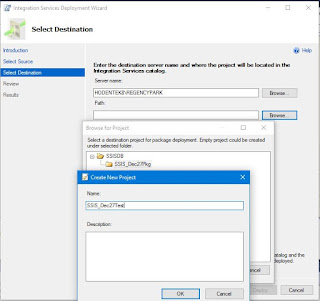
Click New project...The Create New Project window us displayed.

deploy_04e

Provide a name and a description and click OK. The Browse for project window now displays the Project (All these names I have given were taken from my SSIS project created in Parts 1, 2 and 3).

deploy_04f

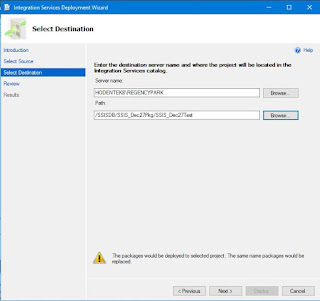
Now click OK. Now the Select Destination page of the wizard has all the needed information as shown.
deploy_04g

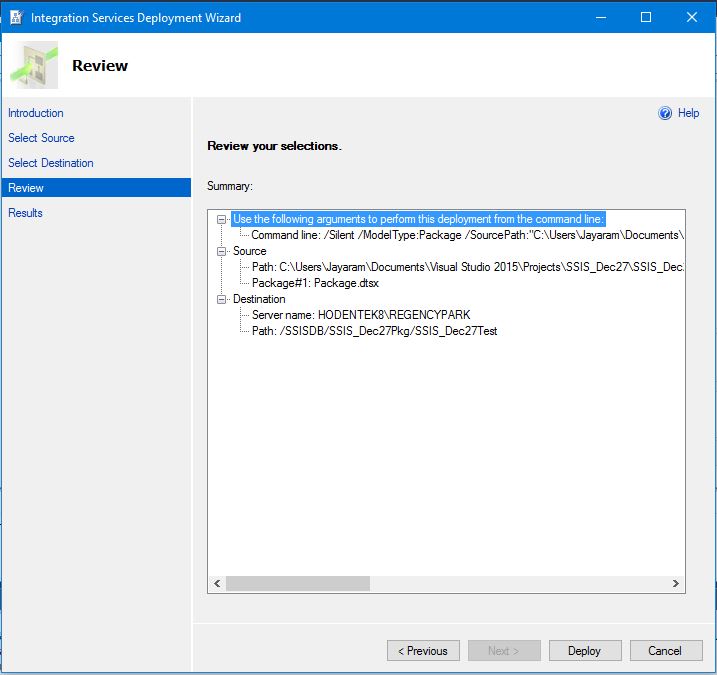
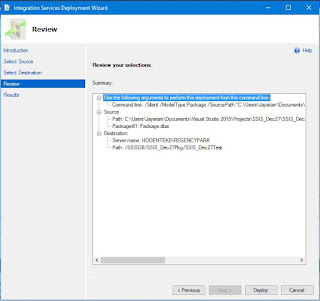
Click Next. The Review you selections section of the Review page is displayed.
deploy_05

Just check the Source and Destination paths and click Deploy.

After some processing the results are displayed in the Result page of the wizard as shown.

deploy_06

Looks like the deployment failed for some reason. Clicking the link Failed brings up the next window.
deploy_07FailedLink.png

The message appears to indicate failing to find a stored procedure. Searching for the package on the SQL Server instance using PowerShell did indicate the creation of folders and projects but did not find the package.
deploy_08.png

On a hunch, the SQL Server Data Tools was closed and opened with administrative privileges and
the package was deployed to the same folder in the SQL Server.

This time the deployment was successful with any errors.


deploy_09.png

The next image shows the package in the Integration Services Catalogs in SQL Server Management Studio.

deploy_10.png

For getting a jump start on SSIS review my popular book and describes some 20 routine tasks that you can configure. The version may be different but the procedures have not changed much.


https://www.packtpub.com/networking-and-servers/beginners-guide-sql-server-integration-services-using-visual-studio-2005

Wednesday, January 6, 2016

Installing SQL Server 2012 SP3 on Windows 10

Service pack SP3 for SQL Server 2012 fixes many of the bugs and adds other enhancements. The list is long, please go here for details.

http://support.microsoft.com/En-us/enkb/3072779

Download your copy if SP3 executable from here:
https://www.microsoft.com/en-us/download/details.aspx?id=49996

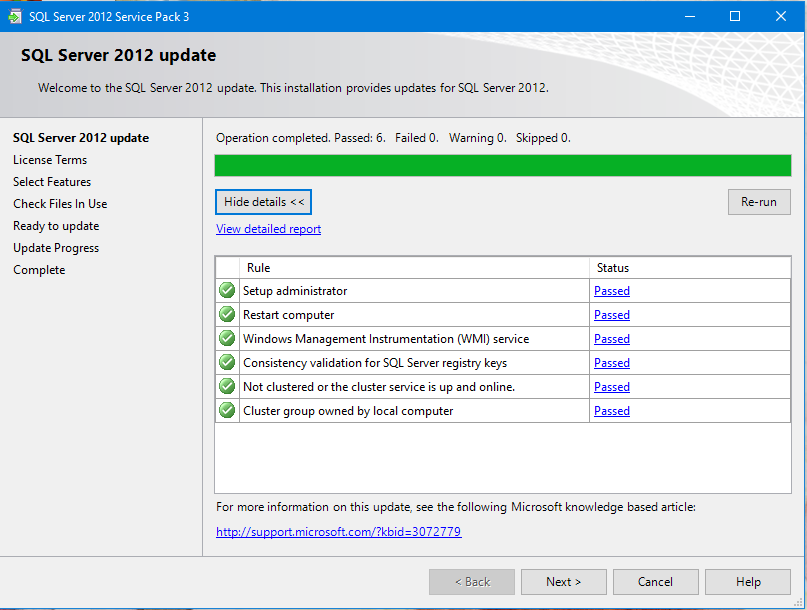
When this executable is clicked the program begins to kick in with this initial window. SQL Server 2012 update checks the files.


SP3_01

Click Next brings in the License Agreement window.


SP3_02
After agreeing click Next.

SP3_03

Selected features for the only existing version of SQL Server 2012, the Regency Park instance.


 SP3_04

This is the present version on this computer. Click Next.


SP3_05

The Check Files in Use command is processed. There were two files active, the Full text directory service and the WD Backup service. These were flagged during ‘Check files in USE’. These were stopped in Control Panel|…|Services window and clicked on the Refresh recheck.


 SP3_06

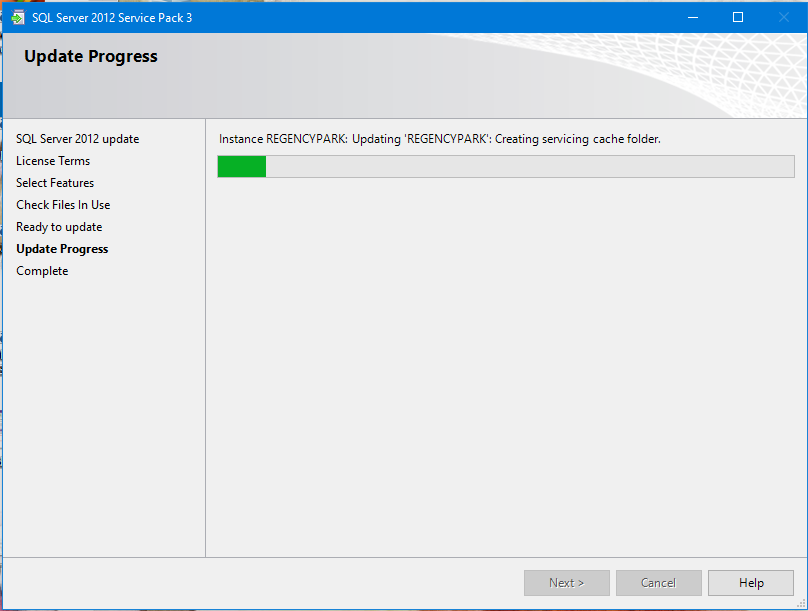
Clicking Update begins the process of the upgrade.

SP3_07


 SP3_08

The upgrade completed successfully. The next two windows shows the same window as above but scrolled to show more info.

SP3_09


  SP3_10

The following changes were made to the program listing in the Control Panel.


SP3_11

After SP3 installation a configuration manager app gets added to All Apps on Windows 10

The version details are as follows:

Developer Edition
11.3.6020.0


Monday, July 14, 2014

SQL Server 2012 Developer Edition: Part 1 Installation

You could get to install a free version of SQL Server Express 2012 without an expiry date but it is not like using all the features available in a Enterprise edition. You could get a few more things in SQL Server 2012 if you install the Express edition with Advanced features. You may also get a Enterprise edition for free, but it is limited for 120 days. What do you do after 120 days, put your system clock back?

The better choice is SQL Server 2012 Developer edition and it has all the features of an Enterprise edition. The downside is you will have to pay for it. It can cost anywhere from $30 to $60 depending on the source. I have had problems with the evaluation editions before and I decided to go for Developer edition.

Some details are here as to where you can download:
http://hodentek.blogspot.com/2014/07/developer-editions-are-better-choice.html

It is also a good training software for a group of say, unemployed folks looking to find a job in the area of SQL Servers. They could buy a developer edition (and each member installing the express edition on his/her laptop/desktop) and use it is a group sharing cost and getting very good (on-the job) training working as a group; checking out features that are available, etc. According to Microsoft the full feature set is available in the Developer edition, except that you cannot use it in production.

 I have described the installation steps many times and one as recently as this:
http://hodentek.blogspot.com/2012/05/sql-server-express-2012-and-localdb.html

I will only make brief remarks for some of the screen shots. The installation is described in great detail in my two books, the first one with SQL Server 2008 and the second with SQL Server 2012.

         
SSRS 2008                                                                                                                     
 
Here I started off with a CD that I purchased from Microsoft Store. The installation was on a Toshiba Laptop computer with Windows 8.1 Professional OS with enough memory. 
As soon as the CD is ready either open the setup.exe or just let it auto play. The first screen you get is the SQL Server Installation Center. Here on the right you can access a lot of information and if it is the first time click on the links and read as much as possible, especially the hardware and software requirements. This is the planning navigation link you find on the left of the screen


Click on the New Installation.. on the right. You will be installing a new named instance of SQL Server.
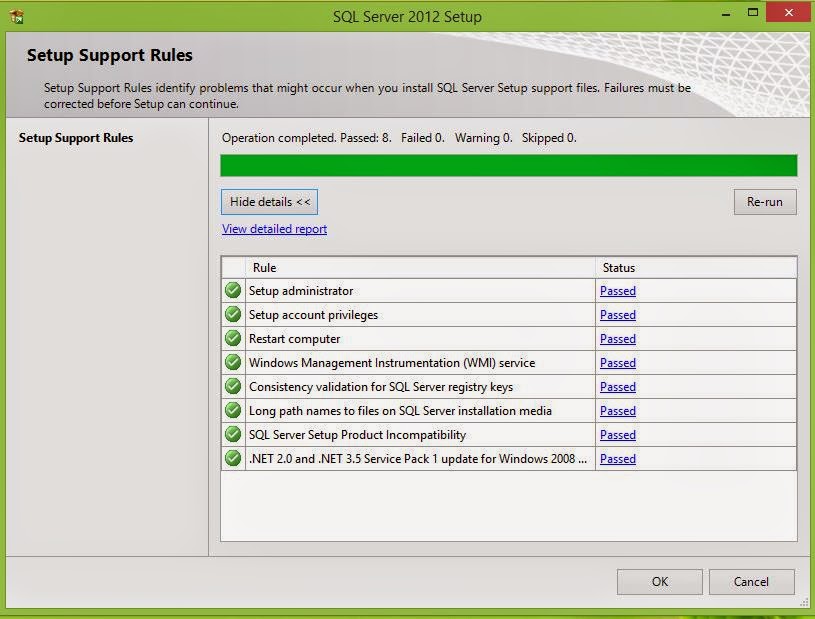
After some processing you will get the Setup Support Rules page where the checks are made. If you do no succeed you may have to full fill the requirements and try again. When it passes all tests you get a screen as shown.
 
 
Click OK. Enter the Product Key and click Next>.


Accept the License  terms (2 check marks ) and click Next


At this point if there are updates they can be downloaded (assumes you are connected to the Internet ) and installed (after you click Next>).

 
 The following is the link to KB Article of the download.

 
Read the notes on this page. The setup rules will be checked. Correct them if necessary and click Next>.

 
 If you click on thee link, for example the one or Windows Firewall you get a message as shown.


In the displayed page you will choose a role for the installation. Choose the option (SQL Server Feature Installation)  shown in the next screen.
 
 
Click Next to display the Feature Selection page shown here. Here all features have been selected. If you click on nay of them, description of what it is, is displayed on the right and the requisites are also shown.


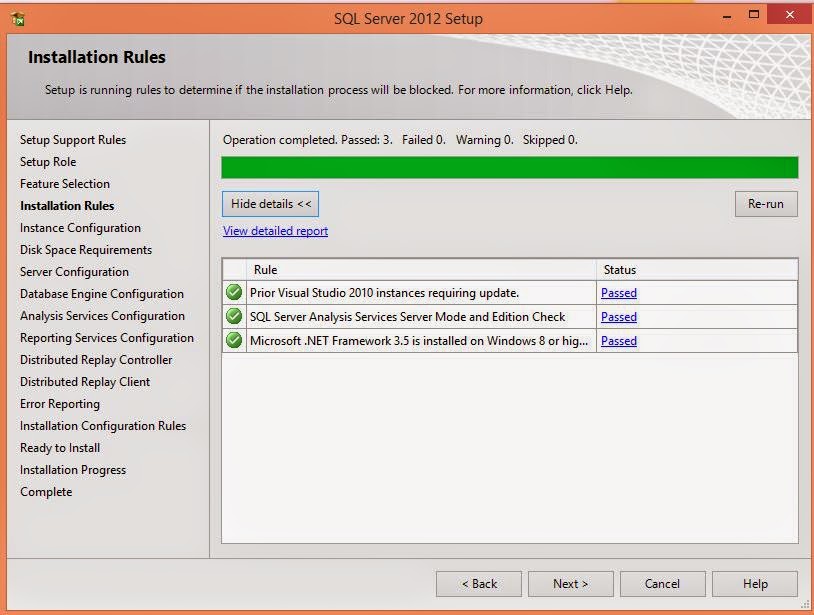
Click Next. Installation rules will be checked as shown. You may consider these as requirements for the installation. If it is lacking you should correct and try again.


Click Next. In the Instance Configuration page you can either create a Named Instance or a Default Instance. For a named instance you can provide your own name. Herein RegencyPark. Some of the text-boxes gets auto filled.

 
If you had had a previous instance it will show-up in the Installed Instances box. Click Next to find if you have enough resources to install in terms of disk space.


Click Next>. You will have to set up the Server configuration for the various components. Microsoft recommends a separate user/login. However, it is best to use the same account/password for all on a single machine which is going to be used by one or two persons. Moreover such caution is not necessary as it is not a production server.

 
In this installation the Windows Administrator (who happens to be the Current User) will administer the SQL Server. His user name/password is registered in the computer. You will be better off hitting the <browse..> button to get to the screens shown here to indicate the Window Login is the current user for all the serer components. Hitting Advanced button brings up the screen on the right. Hit on Find Now and get the drop-down shown where you can select.

 
The Selected User gets added and updates the screen as shown.

 
Click OK

 
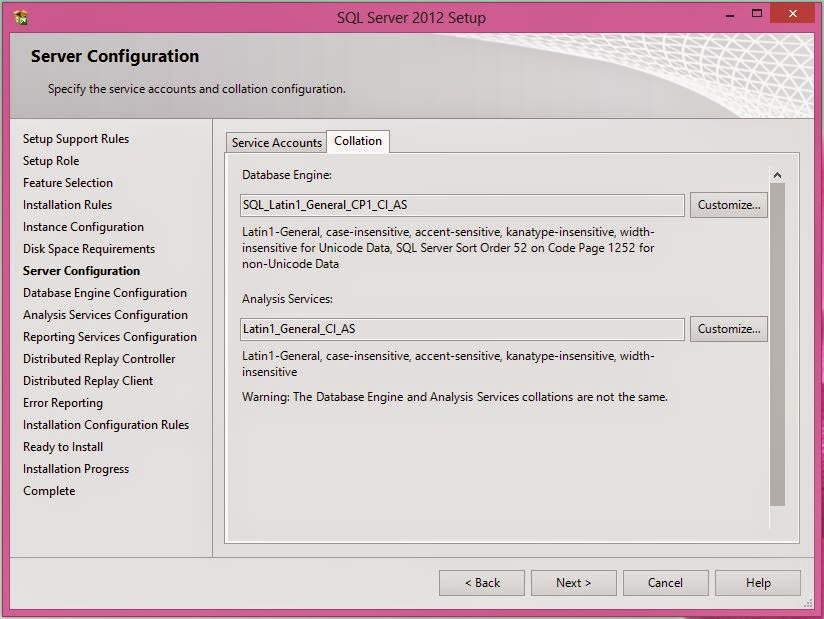
You may have to do this procedure for each of the component that needs username/password. When all of them are set up with username/password click the Collation tab and accept the default.


Click Next to display the Database Engine Configuration page. It has three tabs. In the Server Configuration you need to make the choice of the administrator. Choose Windows Authentication (you could also use the other option, herein the Windows Authentication is chosen). Click Add Current User and the Windows Administrator will be added. You could also add others if they have Windows Login accounts for the computer. You can also remove an existing one. Since this is the first time, only one user is added.

 
In the Data Directories tabbed page you will see the location of various files and you could change the default locations using the ellipsis buttons on this page.
 
 
In the next tabbed page make changes as shown for File Stream.

 
Click Next>. You will added the same administrator for Analysis Services similar to what you carried out earlier. Clicking on Add Current User will suffice. There are two modes from which you need to choose one. Herein the Multidimensional and Data Mining Mode is chosen. The SQL Server 2012 Reporting Services book describes in detail these modes of Analysis Services.

 
The Data Directories tabbed page show where the files are stored and they can be changed as well if necessary.


Click Next. brings you to the Reporting Services configuration page. Choose the option shown. Again the different options for reporting services is described in great detail in the two books whose links were provided earlier.


Click Next and accept the default. Add Current User.

 
In the Distributed Replay Client page provide a name for the controller (your choice).

 
Click Next. and accept to allow Microsoft get access to some information. This is pretty safe.

 
Click Next. The Installation Configuration rules will be checked to make sure that there are no blocking issues.


Click Next and you will see the various components\ sub-components that will be installed.

 
Click Install and the Installation Progress screen is displayed. This may take quite some time and do not pull out.


Finally you get the installation success page as shown.

 
In Part 2: Installation verification


When Identity Security Becomes a Wall — Not a Shield

After a breach that forced a reset of my digital identity, I hit a roadblock I never anticipated: multi-factor authentication (2FA) locked m...